Tag: Architecture

  • Designing for humans: Why most enterprise adoptions of AI fail

    Originally published at https://www.cio.com/article/4028051/designing-for-humans-why-most-enterprise-adoptions-of-ai-fail.html

    Building technology has always been a messy business. We are constantly regaled with stories of project failures, wasted money and even the disappearance of whole industries. It’s safe to say that we have some work to do as an industry. Adding AI to this mix is like pouring petrol on a smouldering flame — there is a real danger that we may burn our businesses to the ground.

    At its very core, people build technology for people. Unfortunately, we allow technology fads and fashions to lead us astray. I’ve shipped AI products for more than a decade — at Workhuman and earlier in financial services. In this piece, I will take you through hard-earned lessons I’ve learned through my journey. I have laid out five principles to help decision-makers — some are technical, most are about humans, their fears, and how they work.

    5 principles to help decision makers

    The path to excellence lies in the following maturity path: Trust → Federated innovation →  Concrete tasks → Implementation metrics → Build for change.

    1. Trust over performance

    Companies have a raft of different ways to measure success when implementing new solutions. Performance, cost and security are all factors that need to be measured. We rarely measure trust. Unfortunate, then, that a user’s trust in the systems is a major factor for the success of AI programs. A superb black-box solution dies on arrival if nobody believes in the results.

    I once ran an AI prediction system for US consumer finance at a world-leading bank. Our storage costs were enormous. This wasn’t helped by our credit card model, which spat out 5 TB of data every single day. To mitigate this, we found an alternative solution, which pre-processed the results using a black-box model. This solution used 95% less storage (with a cost reduction to match). When I presented this idea to senior stakeholders in the business, they killed it instantly. Regulators wouldn’t trust a system where they couldn’t fully explain the outputs. If they couldn’t see how each calculation was performed every step of the way, they couldn’t trust the result.

    One recommendation here is to draft a clear ethics policy. There needs to be an open and transparent mechanism for staff and users to submit feedback on AI results. Without this, users may feel they cannot understand how results are generated. If they don’t have a voice in changing ‘wrong’ outputs, then any transformation is unlikely to win the hearts and minds needed across the organisation.

    2. Federated innovation over central control

    AI has the potential to deliver innovation at previously unimaginable speeds. It lowers the cost of experiments and acts as an idea generator — a sounding board for novel approaches. It allows people to generate multiple solutions in minutes. A great way to slow down all innovation is to funnel it through some central body/committee/approval mechanism. Bureaucracy is where ideas go to die.

    Nobel-winning philosopher F. A. Hayek once said, “There exist orderly structures which are the product of the action of many men but are not the result of human design.” He argued against central planning, where an individual is accountable for outcomes. Instead, he favoured “spontaneous order,” where systems emerge from individual actions with no central control. This, he argues, is where innovations such as language, the law and economic markets emerge.

    The path between control and anarchy is difficult to navigate. Companies need to find a way to “hold the bird of innovation in their hand”. Hold too tight — kill the bird; hold too loose — the bird flies away. Unfortunately, many companies hold too tight. They do this by relying too heavily on a command-and-control structure — particularly groups like legal, security and procurement. I’ve watched them crush promising AI pilots with a single, risk-averse pronouncement. For creative individuals innovating at the edges, even the prospect of having to present their idea to a committee can have a chilling effect. It’s easier to do nothing and stay away from the ‘large hand of bureaucracy’. This kills the bird — and kills the delicate spirit of innovation.

    AI can supercharge innovation capabilities for every individual. For this reason, we must federate innovation across the company. We need to encourage the most senior executives to state in plain language what the appetite is for risk in the world of AI and to explain what the guardrails are. Then let teams experiment unencumbered by bureaucracy. Central functions shift from gatekeepers to stewards, enforcing only the non-negotiables. This allows us to plant seeds throughout the organisation, and harvest the best returns for the benefit of all.

    3. Concrete tasks over abstract work

    Early AI pioneer Herbert Simon is the father of behavioral science, a Nobel and Turing Prize winner. He also invented the idea of bounded rationality. This idea explains that humans settle for “good enough” when options grow beyond a certain number. Generative AI follows this approach (possibly because it is trained on human data, it mimics human behaviour). Generative AI is stochastic — every time we give the same input, we get a different output — a “good enough” answer. This is very different from the classical model we are used to — given the same input, we get the same output every time.

    This stochastic model, where the result is unpredictable, makes modelling top-down use cases even more difficult. In my experience, projects only clicked once we sat with the users and really understood how they worked. Early in our development of the Workhuman AI assistant, generic high-level requirements gave us very odd behaviors and was unpredictable. We needed to rewrite the use cases as more detailed, low-level requirements, with a thorough understanding of the behaviour and tolerances built in. We also logged every interaction and used this to refine the model behaviour. In this world, general high-level solution design is guesswork.

    Leaders at all levels should get closer to the details of how work is done. Top-down general pronouncements are off the table. Instead, teams must define ultra-specific use cases and design confidence intervals (e.g., “90 % of AI-produced code must pass unit tests on first run”). In the world of Generative AI, clarity beats abstraction every time.

    4. Adoption over implementation

    Buying a tool is easy; changing behaviour is brutal. A top-down edict can help people take the first step. But measuring adoption is the wrong way to drive change – instead, it gives box-ticked “adoption” but shallow, half-implemented usage.

    Executives are every bit as much the victims of fads and fashions as any online shopping addict (once you substitute management methods, sparkling new technologies and FOMO for the latest styles from Paris). And it doesn’t take artificial general intelligence to notice that the trend for AI is hot, hot, hot! Executives need to tell an AI story and show benefits, as they are under pressure from shareholders, investors and the market at large. Through my network in IASA, I have broadly seen this result in edicts to measure “AI adoption”. Unfortunately, this has had very mixed results so far.

    Human nature abhors change. A good manager has a myriad of competing concerns, including running a group, meeting business challenges, hiring and retaining talent and so on. When a new program to adopt an AI strategy comes down from executives, the manager — who is trying to protect their team, meet the needs of the business and keep their head above water — will often compromise by adopting the tooling, but failing to implement it thoroughly.
    At Workhuman, we have found that measuring adoption (and not only for AI) is not the right way to begin a transformation. It measures the start of the race, but ignores the podium entirely. Instead of vanity metrics, when we measure success, we measure outcome metrics (e.g. changed work process, manual steps retired and business drivers impacted). By measuring implementation and impact, we avoid the ‘box-ticking’ trap that so many companies fall into.

    From our decade-plus experience in AI, we have also understood that AI transformation is part of a bigger support system, including education, tooling and a supportive internal community. We partnered with an Irish university to run diploma programs in AI internally, and provide AI tooling to all staff, whatever their role. We have also fostered internal communities at all levels to help drive understanding. This has helped us as we deliver AI solutions, both internally and externally, as shown by the release of our AI Assistant, a transformational AI solution for the HR community.

    5. Change over choice

    The AI landscape shifts monthly, with a continual flow of new models and vendors locked in a constant race. A choice that locks you into a single technology stack could have your company resembling a horse and buggy clip-clopping through the center of a modern city in the near future.

    When we began looking at models for our new AI assistant, we faced several challenges. First off, what can each model do? There were few useful benchmarks, and those that existed offered little in the way of business capability insights. We also struggled to measure how the various strengths weighed up against other models’ weaknesses and vice versa.

    Eventually, we agreed on one core architectural principle — everything we design must be swappable. In particular, we must be able to change the core foundation models that underlie the solution. This has allowed us to adjust continually over the last year. We test each new model after release, and work out how each one can be best used to give a great experience to our customers.

    Because models are changing so fast, leaders must have the ability to swap AI models as a core principle. Companies should abstract model calls behind a thin layer, while versioning prompts and evaluation harnesses so new models can drop in overnight. The ability to swap horses mid-race may be the competitive advantage necessary to win in a market today.

    AI for leaders

    Technology choices are leadership choices. Who decides what to automate? Which ethical red lines are immovable? How do we protect every human who works with us? Adopting AI is a leadership challenge that can’t be delegated to consultants or individual contributors. How we implement AI now will define the future successes and failures of the business world. It’s a challenge that must be driven by thoughtful leadership. Every leader must dive in and deeply understand the AI landscape and figure out how best to enable their teams to build the companies of tomorrow.
  • Technical Debt Is Not Debt; It’s Not Even Technical

    Co-authored with Dr Paidi O’Raghallaigh and Dr Stephen McCarthy at Cork University Business School as part of my PhD studies, and originally published by Cutter Consortium’s Business Agility & Software Engineering Excellence practice on 22nd of July 2021

    Take a minute and write an answer to the question, “What is technical debt?” Then read this article and reread your answer — and see if it still makes sense.

    Technical debt is a common term in technology departments at every company where we’ve worked. Nobody explained technical debt; we assumed it was a fundamental property of the work. We never questioned our understanding of it until we discovered a paper by Edith Tom et al. entitled “An Exploration of Technical Debt.” Turns out, we didn’t understand it at all.

    One major concern in academia is rigor. Academics like to get deep into a topic, examine the nuances, and bring clarity. After thoroughly reviewing over 100 seminal papers on technical debt, we saw it as an amorphous ghost, with enormous differences and inconsistencies in its use. Next, we began looking at it in practice, asking colleagues, ex-colleagues, and working technologists, but couldn’t find a satisfactory explanation for it there either. Ultimately, we went back to the original source to figure out the history — and get a sense of its evolution.

    One thing that is agreed on: the term technical debt came from Ward Cunningham. Cunningham is the inventor of the wiki and a tech legend. In the early 1990s, his team was building a piece of financial software, and he used a metaphor from the world of finance to explain to his manager how the team was working. As he later explained in a paper at the OOPSLA conference in 1992:

    A little debt speeds development so long as it is paid back promptly with a rewrite. Objects make the cost of this transaction tolerable. The danger occurs when the debt is not repaid. Every minute spent on not-quite-right code counts as interest on that debt. Entire engineering organizations can be brought to a stand-still under the debt load of an unconsolidated implementation, object-oriented or otherwise.

    The metaphor quickly became part of standard technology discourse. Because the conference focused on object-oriented development, it took hold in that community. Popular tech authors such as Martin Fowler and Steve McConnell soon took it on, helping it become part of the broader language in software development. Today, the use of “technical debt” has become commonplace, from a mention in a single paper in 1992 to over 320 million results from a Google search as of July 2021.

    Over time, Cunningham saw the term shift to signify taking a shortcut to achieve a goal more quickly, while intending to do a better job in the future. In 2009, dissatisfied with how the metaphor had mutated, he clarified the use of technical debt in a YouTube video. Cunningham disliked the notion that technical debt signified “doing a poor job now and a better one later.” This was never his intention. He stated:

    I’m never in favor of writing code poorly, but I am in favor of writing code to reflect your current understanding of a problem, even if that understanding is partial.

    But it was too late. By that time, the metaphor had outgrown his initial intent. It was out in the wild, excusing terrible decisions all over the globe. Technical debt now represented both debt taken on intentionally and the more insidious form, hidden or unintentional debt — debt taken on without the knowledge of the team. It had also moved past code and spread to areas as varied as technology architecture, infrastructure, documentation, testing, versioning, build, and usability.

    Technical debt allows practitioners to look at tech delivery through the lens of debt. Is this an appropriate lens? Debt repayment has one vital characteristic: it is easy to understand. Debt repayment has three properties that are straightforward to grasp — principal amount, interest rate, and term (i.e., length of time to repay). But when comparing technical debt, there is no agreement on the principal, no agreement on the sum owed. There is no concept of an interest rate for technical debt because technologists individually evaluate each project as a unique artifact. Finally, term length isn’t a fixed concept in technical debt — in fact, Klaus Schmid even argues that future development should be part of the evaluation of technical debt.

    Enormous effort and energy have gone into trying to calculate an accurate number for technical debt across many technology and academic departments. Unfortunately, trying to glue a direct mathematical representation to a metaphor seems to have failed. The idea of technical debt as a type of debt doesn’t hold up well in this light.

    So is it technical? This depends on whether we consider only the originating action, or the consequences that follow. If an aggressor punches a bystander in the face, we consider not only the action of the aggressor (the originating action) but also the injury to the bystander (the impact of that originating action). Through this lens, technical debt can only be technical if we consider where it originates, as opposed to where it has an impact. Technologists take on the originating action; the business suffers the impacts of those decisions. Technical debt affects:

    • Competitiveness by slowing/speeding up new product development
    • Costs (short-term decrease/long-term increases in development cycles)
    • Customer satisfaction
    • Whether a company can survive

    Once we realize that technical debt is a company-wide concern, we can no longer consider it technical. This label is too narrow and doesn’t communicate its significance. In fact, our current ongoing research shows that technical debt may even have an impact beyond the company, and we need to take an even broader view (its effect on society as one example). 

    The most important takeaway: we must broaden our awareness of technical debt. In the same way that company executives examine financial cash flows and sales pipelines, we must communicate the consequences of taking on technical debt to this audience. Our most important challenge is to find a shared language to help business stakeholders understand the importance of unknown decisions made in technology departments.

    Finally, look back at how you defined technical debt at the beginning of this article. Do you communicate the action or the impact? Is it suitable for a business audience? What is?

  • Buffet-Style Architecture

    The New World of Public Self-Governance

    If I had asked people what they wanted, they would have said faster horses.

    — Attributed to Henry Ford


    The tendency to cling to the past when predicting the future is clear throughout history. This is as true today as it ever has been. Even in the future-defining world of technology, people still cling to anachronistic ideas.

    To get the structure of the business right, a company must reorganise itself around empowered teams that can operate at speed. For technology architecture to play a pivotal role, it must leave the old workhorses of the past behind and move to modern transportation. Indeed, architecture must refocus on three core principles: (1) accelerated change, (2) decentralised decisions, and (3) public self-governance.

    Why Does Any of This Matter?

    Recall these three promising businesses that crashed and burned in the midst of major technological change?

    1. At its peak, telecoms giant Nortel had almost 100,000 staff members and celebrated over 100 years of success. In 2009, it filed for bankruptcy.
    2. In 1988, Kodak celebrated 100 years of existence, buying Sterling Drug for US $5.1 billion; in January 2012, it, too, filed for bankruptcy.
    3. In 2008, social network Friendster had more than 115 million registered users and was among the top 40 visited sites on the Internet. It shut down all operations on 14 June 2015.

    All three businesses attempted to transform far too late. In each case, the company clearly saw a disruptive change emerging in its path. Early on, each business thought that the disruption was merely a fad and that size and history would offer protection from it. Ultimately, they all failed.

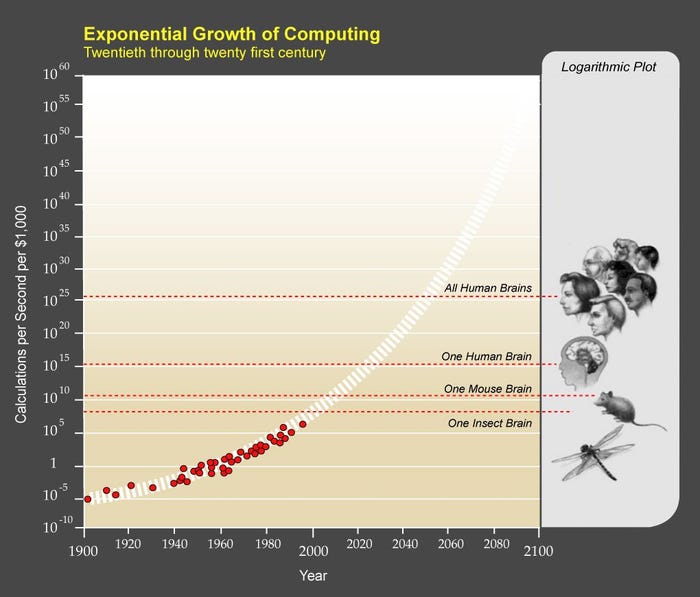
    The world has not been slowing down since these companies found themselves in trouble; it has been speeding up dramatically. In his essay, “The Law of Accelerating Returns,” inventor and futurist Ray Kurzweil explains that “technological change is exponential, contrary to the common-sense ‘intuitive linear’ view. So, we won’t experience 100 years of progress in the 21st century — it will be more like 20,000 years of progress (at today’s rate)”’

    Kurzweil uses multiple cases to show that the evolution of technology is increasing at an incredible pace.

    Incredibly Ray Kurzweil gave personal permission for use of the diagram above

    The diagram above shows a good representative example, where computing power goes from the equivalent of an insect’s brain in the year 2000, up to a human brain’s in 2025, to all human brains by 2050. Supporting this type of exponential growth might be the single most important thing a company does for its survival. If a company can’t adjust quickly, it may have to shut its doors as new business strategies hand the advantage to competitors.

    How Is EA Meeting This Challenge?

    The answer to this question really depends on what “enterprise architecture” (EA) means. No single clear identity exists today for architecture in an enterprise. Indeed, the ISO/IEEE site lists 78 separate architecture groups with associated frameworks. These different groups aggressively defend their “one true answer,” recalling the poetic words of W.B. Yeats in “The Second Coming”:

    The best lack all conviction, while the worst

    Are full of passionate intensity.

    While inside the architecture community an argument over the best framework rages, to outsiders it resembles crows fighting over scraps at the dump. The winner is important to the crows and a few bystanders but relatively unimportant to the rest.

    More important than architectural identity is understanding the value architecture brings today. The value of a sales division is clear: to bring in revenue; the finance division’s value is to manage the company finances, and so forth. A typical department knows its value proposition thoroughly. A member of a well-run department can explain its contribution in an elevator and still have time to discuss last night’s game before reaching the desired floor. However, it is rare for an architect to speak about architecture’s value to the company in clear business terms.

    In the quest to uncover the value of architecture, academic research fares no better, showing that despite all expended effort, framework-based architectures have failed to deliver. Complexity and the increased rate of change in technology have transformed the business landscape, but architecture hasn’t kept pace. The following quotes from academia and industry groups provide some insight:

    • There exists no single comprehensive view of the ways an architectural practice might add value to an organisation. — Vasilis Boucharas et al.
    • Measuring EA effectiveness is often deemed difficult by both practitioners and researchers. — Wendy Arianne Günther
    • Useless at best, and harmful at worst. — Svyatoslav Kotusev

    What Should Architecture Do?

    Architecture should play a key role in creating the strategy for a digital business. But strategy alone is not enough. As famed organisational theorist Jeanne Ross notes:

    “A great strategy is valuable only if a company is capable of executing that strategy. And whether or not a company can execute its strategy depends largely on whether it is designed to do so. In other words, it depends on business architecture — the way a company’s people, processes, systems, and data interact to deliver goods and services to customers.”

    So, as we hinted to earlier, architecture must go deeper by focusing on three pillars: (1) accelerated change, (2) decentralised decisions, and (3) public self-governance.

    The Three Pillars of Digital Architecture

    1. Accelerated Change: Optimise for Speed

    As we know, external change is happening at an exponential rate. This changes the speed of execution from a useful to a critical success factor. If companies aren’t readying themselves and getting their business architecture right today, they increase the chance of becoming irrelevant tomorrow.

    Companies slow to change have always been at a disadvantage. My first-person experience of this comes from my time working at a small telecoms company in Ireland in the late 1990s, leading a team of three. Telecoms consumers began to ask for additional content, such as recommended listings, sports scores, and local weather. Providing this content meant that operators could charge more and increase revenue.

    We spent five months building a new workstation platform that offered these new services and then flew to Nortel in Rochester, New York, USA, hoping to sell it. It turned out that a team of 50 people in Nortel had been working for two years to build the same platform and were nowhere near completion when we showed up. The key difference was that Nortel’s organisational structure slowed them down, while ours allowed us to move as fast as we could.

    In the end, Nortel took so long in deciding whether to buy our software, we approached a telco directly and won the deal ourselves, in effect becoming a competitor. The world outside Nortel started to move faster than the world inside, but they didn’t notice until it was too late, contributing to the downfall of this once great institution.

    Today, companies must reorganise quickly so that they can move faster, keep up with the external rates of change, and avoid becoming the new Nortel. Optimising for speed means shortening the time from idea to implementation — from lightbulb to lights on.

    2. Decentralised Decisions: Power to the Teams

    Hurricane Katrina hit the US in 2006 causing fatalities, lost homes, and devastation in many towns and cities, including New Orleans, Louisiana. The agency with overall responsibility for disaster management was the Federal Emergency Management Agency (FEMA). Most agencies tasked with providing relief, FEMA in particular, did not do so adequately. The top-down chain of command was mostly useless when those on the ground needed to make immediate decisions. People felt disempowered and stifled by bureaucracy.

    One notable exception was Walmart. Walmart shipped almost 2,500 truckloads of merchandise and medication to New Orleans before FEMA even began any relief efforts and provided trucks and drivers to community organisations. How was Walmart able to act almost immediately after the hurricane when the government agencies responsible for providing relief took days (sometimes weeks) to get to affected areas?

    A key reason is Walmart’s decentralised decision-making. The company gives both regional and store managers authority to make decisions based on local information and immediate needs. As Hurricane Katrina approached, Walmart CEO Lee Scott sent a message directly to his senior staff and told them to pass it down to regional, district, and store managers:

    “A lot of you are going to have to make decisions above your level. Make the best decision that you can with the information that’s available to you at the time, and, above all, do the right thing”.

    On the ground, Walmart staff turned stores into emergency sleeping quarters, set up temporary police headquarters, and, in one case, ran a bulldozer through a store to collect undamaged supplies and give them to those in need. People could make life-saving decisions because they didn’t need to wait for permission. They already had permission as part of their job.

    Today, in a world of accelerating change, companies must empower teams like Walmart did. To achieve this, decentralising the decision-making process is vital – it empowers individuals and reverses bureaucracy, which is toxic to innovation. As world- renowned business thinker Gary Hamel and his coauthor Michele Zanini note in Harvard Business Review,

    “Bureaucracy is the enemy of speed … bureaucracy is a significant drag on the pace of decision-making in their organization”.

    So, how does architecture enable decentralised decision-making, reduce bureaucracy, and accelerate work? Public self-governance helps answer this question.

    3. Public Self-Governance: From Governance Blockades to Buffet-Style Decisions

    Traditional technology governance resembles theatre, where various stakeholders play parts in a process that makes the actors feel satisfied. The decided lack of applause from the enterprise is telling.

    Governance committees decide centrally, causing delays in work and frustration to parties awaiting an outcome. They rarely have the same level of information as the team on the ground. Of course, the committees can request more details, but this only increases delays. Occasionally, they assume knowledge and rule on matters in semi-ignorance, acting like an unaccountable early European monarchs.

    The book Accelerate discusses highly sophisticated and complex technology projects. In considering the usefulness of a change advisory board (CAB) or central approval process, the authors found that:

    “External approvals were negatively correlated with lead time, deployment frequency, and restore time, and had no correlation with change fail rate. In short, approval by an external body (such as a manager or CAB) simply doesn’t work to increase the stability of production systems, measured by the time to restore service and change fail rate. However, it certainly slows things down. It is, in fact, worse than having no change approval process at all”.

    A central approval process is akin to a restaurant with only one server. The server can handle a few tables. As the company grows, the number of tables also grows. The order queue gets bigger and diners face a longer wait. Eventually, diners are upset, the food gets cold, the server is exhausted, and ultimately quits. We need instead to move to a buffet model, where diners can serve themselves, the food is hot, and a smiling server is on hand in case anything additional is needed.

    Enterprises must move away from the old model of centralised decision-making to a model of public self-governance. Away from monarchy and toward democracy, giving teams the knowledge and authority to make decisions in the open.

    What Is Public Self-Governance?

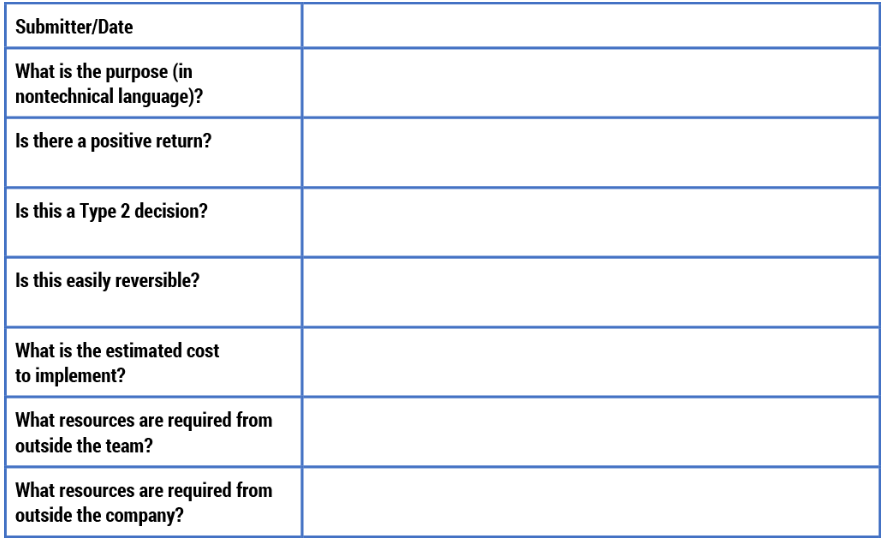
    Public self-governance is a simple process, where teams ask themselves three questions after first stating the purpose of the proposal:

    1. Is there a positive return?
    2. Is this a Type 2 decision?
    3. Is this easily reversible?

    If all three answers are yes, then the team makes the answers available internally and begins work immediately. This process increases the speed of decision-making, increases autonomy within teams, and creates a culture for innovative ideas to blossom. Team members are more engaged, and both they and the company reap any rewards that materialise. Let’s break these questions down.

    A. Is There a Positive Return?

    This question concerns the business case and is merely asking whether the ROI is greater than the cost. This simple question, however, has a deep impact, helping people at every level of an organisation consider ROI as they dream up new proposals.

    B. Is This a Type 2 Decision?

    This question considers scope and comes from Amazon. Jeff Bezos, in his 2015 letter to shareholders, explained the two types of decisions within Amazon: Type 1 are high-impact choices, while Type 2 are lower-stakes choices that can be more easily reversed. Amazon leaves Type 2 decisions to its teams.

    With public self-governance, an individual at any level can make a Type 2 decision, which provides autonomy and allows immediate action. Type 1 decisions are made by senior stakeholders with consideration of a wider set of factors (e.g., risk, business environment, company performance, alignment with strategic goals). Training individuals to distinguish Type 1 from Type 2 decisions is part of an enterprise’s learning journey.

    C. Is This Easily Reversible?

    This question concerns complexity. If a proposal needs integration into existing systems, or requires new data, complexity increases. The higher the level of complexity, the greater the work needed to reverse the action. To answer this question, one must break it down further and consider the following three categories:

    1. Data. Is the data protected? Can it be retrieved and/or deleted?
    2. Integration. Are integrations or custom development required? Is this work easily reversed?
    3. Users. How does removing the feature impact its users?

    The answers to all public self-governance questions should be openly available within the company, and the architecture group should perform continuous retrospective reviews. If any issue arises, or if any of the three answers is no, the architecture group then becomes a partner, helping to generate a business case and thoroughly work through the proposal. This proactive approach allows other teams without issues to move forward with no delays.

    Public self-governance requires a culture that encourages experimentation and is tolerant of failure. If something is easily reversible, then it is low risk. If it doesn’t deliver as expected (i.e., less value, higher cost, more complexity), it can be halted, with lessons noted, and everybody can then move on to the next decision.

    Other Considerations

    Financial Purse Strings

    “Negotiating budget exceptions — often necessary when a company has to move quickly — was also impeded by bureaucracy” — Hamel and Zanini

    In most companies, costs will also need finance approval. Bureaucracy costs money; therefore, it is cost effective to give blanket approval to all proposals below a set maximum amount.

    Danger: Technologists in Control!

    A word of warning: it is important to review answers to the public self-governance questions, continue an open dialogue, and support a learning culture. There is a difference between giving increased autonomy to technologists and abdicating any responsibility as a firm. The cautionary tale of Netscape should serve as a stark reminder of too much free rein given to technologists.

    In 1995, the Netscape Navigator browser had over 80% of the market. Riding on this wave of success, Netscape began to rewrite the browser entirely, so it would support its newly created JavaScript programming language. Netscape intended to obliterate the all-conquering Microsoft, making Windows, according to Netscape VP of Technology Marc Andreessen, appear like a “poorly debugged set of device drivers.”

    To the technologists in the firm, this was an obvious choice: rewrite the entire browser (i.e., the entire business) from scratch, removing old code and old bugs. It was just a matter of cleaning out the cobwebs to prepare for a new paradigm shift.

    The full rewrite took two years — two years without new features, without meeting new customer needs, or dealing with competitive threats. By the time Netscape released its new Netscape Communicator browser, Microsoft Internet Explorer was everywhere, and Windows was the desktop platform of choice. Meanwhile, Netscape’s market share slid irreversibly, from close to 90% in 1995, dropping to 5% by the end of 2001. Netscape went from total dominance to a vague footnote. Plus, in an ironic twist, the new browser was buggy and slow compared to the old version.

    AOL ended up purchasing Netscape in early 1999, and, by 2003, the company disbanded altogether, an ignominious end to what had looked like a brilliant future only eight years earlier. Here, Andreessen made a major decision solely on a technology basis. Referring to the public self-governance form, this was a Type 1 decision made as if it were Type 2. Netscape should have considered an array of factors, including risks, business strategy, and competitive threats. Ignoring these factors ultimately caused its demise.

    As we see in the Netscape example, judgment is still necessary in making good quality decisions. Using public self-governance allows a business to scale its decision-making, but a business must also reinforce the learning culture so that staff members understand how to categorise their proposals and make better decisions.

    Conclusion

    To survive in this digital age, architecture must change. The old monsters of heavyweight governance, centralised authority, and long wait times are impediments in this new arena. Public self-governance breaks up decision hierarchies and speeds up technology decisions in the organisation. It encourages a business to move faster. This will have an enormous impact, allowing companies to adjust quickly to customer needs, changes in technology, and emerging business models. Public self-governance is a necessary step in setting a business up for success in this new era.

    This article originally appeared in Vol. 32, No. 9 of Cutter Business Technology Journal

  • How Technology Architects make decisions

    Or why you might spend a fortune on a red car

    Chinese translation available here

    The remarkable Herbert Simon won the Nobel Prize in Economics in 1978 and the Turing Medal in 1975. Reading about his life gives me a panic attack when I consider how little I have achieved in comparison. He published ‘Administrative Behaviour’ in 1947, and I started reading it in 2021. I started by treating it as a relic of World War II era business, a history book. It quickly filled me with horror as Simon explained business, thinking and decision making in ways which seemed obvious after reading them, but I had never even thought of. I immediately felt weak. I felt like a total imposter. How had I never read Herbert Simon before? Why had nobody told me? It panicked me for days. I dropped a reference to the book into every meeting for weeks. That practice soon calmed me down. It turns out almost no-one I know had read it either.  

    Early in the book, Simon talks about how each department in an organisation has one job. They take in information and turn it into decisions which are executed (either by them or another department). He introduces the concept of Bounded Rationality – how it is impossible to evaluate an almost infinite set of possibilities when making a decision. Instead, we must choose a smaller ‘bounded’ set of assumptions to work within. 

    Back in the actual world of architecture, I have always boiled the job down to either a) making decisions or b) provide information to help others make decisions. I’ve only ever had a vague sense of how architects make decisions, even though it’s been my job for the majority of my career.

    In a fantastic paper published in 2014, “EA Anamnesis: An Approach for Decision Making Analysis in Enterprise Architecture”, Georgios Plataniotis, Sybren de Kinderen and Henderik Proper explain the importance of capturing decisions made about architecture. They go further, arguing that capturing the reasons for a decision and alternatives considered is just as important. Documenting the rationale when a decision is made gives it context, explains the environment at the time, and helps inform future decisions. 

    The paper describes four strategies used to make Enterprise Architecture decisions. Each decision is an attempt to decide on the best alternative among competing choices. They split decision types into the following buckets :

    • Compensatory. This type of decision considers every alternative, analysing all criteria in low-level detail. Criteria with different scores can compensate for each other, hence the name. There are two types here:
      • Compensatory Equal Weight – criteria are scored and totalled for each potential option, the option with the highest total signifies the best decision. 
      • Compensatory Weighted Additive (WADD) – here a weighting is given for a criterion to reflect significance (the higher the weighting, the higher the significance). The weighting is multiplied by the score for each criterion, then each alternative is summed, the highest total winning. 
    • Non-Compensatory. This method uses fewer criteria. The two types are:
      • Non-Compensatory Conjunctive – alternatives that cannot meet a criterion are immediately dismissed, the winner is chosen among the survivors. 
      • Non-Compensatory Disjunctive – an alternative is chosen if it complies with a criterion, irrespective of other criteria. 

    Say you were buying a car, and you had the following criteria: fuel efficiency, colour, cost, and ease of parking (as scored below). 

    CarFuelColourCostParkingTotalFuel x2 Weighted Total 
    Car A9Black64191828
    Car B6White105211227
    Car C4Grey41018822
    Car D1Red1810211

    The four strategies might look like this: 

    1. Compensatory Equal Weight – in this case you pick the highest unweighted total – Car B
    2. Compensatory Weighted Additive – because you drive long distances, you apply a double weighting for fuel mileage and pick the highest weighted total – Car A 
    3. Non-Compensatory Conjunctive – because you live in a city, you discard any car that isn’t easy to park (at least 7/10). This leaves a choice between C and D you chose the highest score between them – Car C 
    4. Non-Compensatory Disjunctive – you fall in love with a red car – ignore everything else – Car D

    Compensatory decisions are suitable when time and resources are available to   

    • gather the right set of alternatives, 
    • evaluate each alternative in detail
    • score each with consistency and precision. 

    Non-Compensatory decisions are necessary when

    • there is time stress
    • the problem is not well structured  
    • the information surrounding the problem is incomplete
    • criteria cant be expressed numerically
    • there are competing goals
    • the stakes are high
    • there are multiple parties negotiating in the decision. 

    A level of pragmatism is important when choosing a decision strategy. Using Simon’s concept of bounded rationality, compensatory decisions can never be fully worked out. Some level of assumptions are necessary, otherwise the work needed to make every business decision is almost infinite. However, within a set of ‘givens’ (given we need to decide by Friday, and given budget is x, and given resources available are y, and given etc) the weighted additive method (WADD above) has proven effective in my experience. The framework forces decision makers to consider each alternative clearly, as opposed to a clump of criteria mashed together. It also forces all parties to agree a set of weights, helping the group agree on the hierarchy of importance. These processes improve communication between parties, even when they disagree on the choices of criteria and weights. 

    A strange magic happens during negotiation of the scoring, as parties try to force their choice. The mental mathematics going on inside heads is a dizzying. I have witnessed all types of behaviour, from people determined there be no change, to an exec wanting an inflight magazine article to form the basis for all future strategy, to a head of a business unit wanting us to use his nephews school project as part of the solution, all the way to one mid 40s executive, who got so annoyed with the debate, that he started jumping up and down and stamping his feet because he wanted his decision, and “that’s what I’ll get”. 

    Start now


    Since first posted, this article has been subsequently published by Architecture and Governance magazine here

  • Slides and links from the IASA BIL-T Conference

    I am delighted to speak at the IASA BIL-T Conference (you can still register here), particularly given my earlier post about how we can make the best of the Covid Situation. Please drop me a line here or on Twitter of LinkedIn if you’d like to discuss, well, anything really.

    Please thank a healthcare worker here . It only takes a couple of seconds, and gratitude helps both the giver and the receiver.

    This is the essay from Ray Kurzweil on the Law of Accelerating Returns, detailed and fascinating. It will change the way you think about change! His paper on how his predictions have fared is fun and astonishing in parts here
    The book Accelerate is a must read on building and scaling tech organisations and is here 

    Merrill Chapmans book on Tech disasters is ‘In Search Of Stupidity’. It is hilarious and horrifying, and is available here.

    The Cutter Journal article I wrote on Public Self Governance is available for free (after you enter your name and email) here .

    Make it a great summer!

  • Rapid Change Reading List

    Thank you to everybody who attended my talk at AtlanTec Virtual Festival of Technology. Particular thanks to the organising committee for putting on such a fantastic Virtual event. It was a great pleasure to talk about Rapid Change, a subject I am passionate about. There were a few requests for the reading list, so I’ve included the links below.

    The most important link is the essay from Ray Kurzweil on the Law of Accelerating Returns, detailed and fascinating. It will change the way you think about change!  . 
    His paper on how his predictions have fared is fun and astonishing in parts. 

    The book Accelerate is a must read on building and scaling tech organisations

    Merrill Chapmans book on tech disasters is called ‘In Search Of Stupidity. It is hilarious and horrifying, and is a truly wonderful history of tech disasters

    The Cutter Journal article I wrote on Public Self Governance is available for free (after you enter your name and email) here .

    One last word. Three days before the publication of my article in the Cutter Journal, the editor got in touch and asked if I had permission to use Ray Kurzweil’s diagram. I was in a panic, and I knew that there was no way I could get permission in time. I would have to replace it myself and rewrite the section, then have it re-edited and fact checked, probably missing the deadline and my opportunity. Getting published in this journal was an enormous deal to me as so many people who I look up to have published there (Kent Beck, Ward Cunningham, Alistair Cockburn to name a few).

    I emailed the Kurzweil site and went to bed depressed. I awoke the next morning and found that Sarah, who works for Ray, had sent me a note telling me that Ray had given me permission to use the diagram. All he wanted in return was a copy of my article. 

    Ray Kurzweil, visionary, genius, gentleman.

  • I’m speaking at the wonderful Atlantec Virtual Festival of Technology on Friday the 22nd of May

    I’m speaking at the wonderful Atlantec Virtual Festival of Technology on Friday the 22nd of May

    There is a wonderful Technology Event based in Galway called Atlantec. This festival of technology has been hugely successfully since 2015. Despite their impressive track record, they asked me to speak in person this year. Unfortunately, with the current Covid situation, the in person event is cancelled. Undeterred, the hosts have reacted positively and created an online event instead. It’s now a Virtual Festival of Technology and this free event and has a fantastic lineup here: https://atlantec.ie

    It’s at 12:00 (BST) on Friday, a perfect companion to a lunchtime sandwich. Please click here to register  https://www.eventbrite.ie/e/atlantec-virtual-festival-30-tech-events-over-5-days-registration-104118994716?aff=AtlanTecVirtualFestival

    I’ll present a decision process to assist with managing rapid change. In the process I’ll discuss Hurricane Katherina, drilling for Oil, Ray Kurzweil, a chessboard and Rochester, New York. Exponential growth of technology change is happening, and it’s vitally important to react to it before it consumes your technology department and eventually your firm. The Cutter Journal published my paper on Rapid change in the November 2019 issue, and the journal are making the paper free to access for all Atlantec attendees at https://www.cutter.com/offer/buffet-style-architecture-new-world-public-self-governance.

  • The most underrated skill in technology discussed. Video interview on Architecture at Workhuman

    The most underrated skill in technology discussed. Video interview on Architecture at Workhuman

    I recently did a video interview with Silicon Republic. I describe life at Workhuman and explain what running Architecture here means.

    I discuss careers and how important challenges are. Challenges help you find where your boundaries lie. Pushing past your boundaries shows how far you can go. You may have more ability than you think, or you may fail and fall down as I often have. Falling down doesn’t matter in the slightest once you get back up again.

    I’m a strong believer in the importance of creativity in technology, so that gets a big mention. It is the most underrated skill needed for success.

    Jordane’s amazing art is one of the unexpected treats at Workhuman, you can see her in action. Finally, the eagle eyed among you may even spot the reddest neck in technology!

    The Full article is here http://www.siliconrepublic.com/video/workhuman-challenges-video

  • What we Can Do during this uncertain time

    What we Can Do during this uncertain time

    This is an unprecedented time in life. It feels like the usual world has paused. I was working in Florida last week when the seriousness of Covid19 hit me. Texts, email, media posts from everywhere came flooding in. Somebody told me that the US were stopping all flights to Europe. I froze when I heard this. My family were 5,000 miles away. Flights to Ireland didn’t stop, but I worried every second about the possibility not seeing my two little boys until I landed back in Dublin. They didn’t seem to be so concerned about me; they were aggressively interested in how long they would have to wait to get their presents. My wife was happy enough to see me until she got her gift. “Is this all you got me, a book? They sell these in Ireland, you know”. I was thrilled to be back home.

    Even after I came home I spent days worrying, trying to figure out what was happening with the Coronavirus. Had I bumped into an infected person? Was the restaurant table at the airport laboratory clean as I would expect? Was I already infected? Would the kids be ok? What about my parents? Would we have enough food if the shops closed? I felt totally overwhelmed.

    I had a sharp realisation. The situation with Covid19 is happening and I can’t change it. I can try to help those around me, but I’m powerless to change the global situation.

    I can choose how to react. I am choosing to find the opportunity in it.

    Soon the virus will be under control, and the world will be back to normal. A slightly new normal perhaps, but normal all the same.

    I won’t spend the time over the next few months gossiping, trying to predict what happens. I won’t spend it scrolling through endless social media posts. I won’t spend it passive aggressively arguing about pseudo science with my wife (“ok so you’re an epidemiologist now Mark“). Instead, I’m determined to put in place a routine where I can learn so I become better at something every day.

    For the next 2 months I will spend 60 minutes every day on something which improves my life for the better.

    I will research and write an academic paper on decision making in Technology Architecture. As I am working from home for the next few weeks, I will use the time I’d have spent commuting. This new knowledge will help me improve the work-lives of every customer we have at Workhuman. It will also make me a better technologist for the rest of my career.

    Please find one thing for you to do.

    Pick one thing that would alter your life. Is it a new skill, a skill that will help others, a passion that you’ve not had time for?

    You can learn to program, begin an exploration of Jazz or Classical Music. You can write a blog, an article, a book. You can read a self-improvement book, take a course in Coursera, or indulge a passion almost forgotten for years. Maybe you’d like to learn how to ride a unicycle.

    Find something to do and tweet at me. I will tweet every morning. Lets give each other support in this time to improve the world. @markgreville #ChooseOpportunity

    Lets take care of each other and stay positive where possible. Together we are stronger.